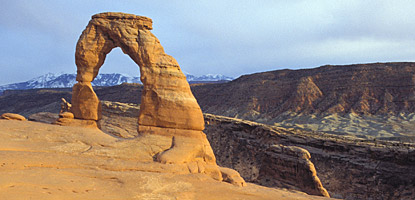
I just blogged on Marley Acers about our trip to Moab. I've never been there this time of year before and was amazed by the natural desert world getting ready for winter. One thing in particular caught my eye: The Utah juniper (Juniperus osteosperma) in all it's fall glory.
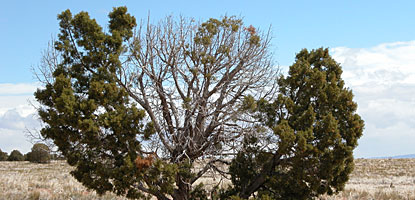
"The Utah juniper is the classic desert tree. Its twisting, often-dead branches seem to epitomize the struggle of life with little water. When moisture is scarce, a juniper will actually stop the flow of fluids to some outer branches so that the tree has a better chance for survival. Scale-covered leaves and bluish, waxy-coated seeds help the tree conserve moisture."

The "berries" are what caught my eye, they absolutely COVER the trees in fall giving them an otherworldly appearance in the stark landscape. We stopped to look close up at the berries. I went on to learn that in botanical terms the the Utah Juniper is "a monoecious conifer".

"Conifer" means the "berries" are actually cones (like pine cones) but covered with a waxy flesh to protect the seeds from the heat.
"Monoecious" means that both sexes are on the same plant, meaning each individual tree is capable of surviving and reproducing alone, even if every other Utah Juniper in the world were to die! The craziest thing about that is that around 10% of plants have evolved to become dioecious, producing cones of only one sex.
Fascinating.


 Caddilac Mountain


 Otter Cliffs


